El qué dirán. Almost every Latina has heard of it. For a lot of us, it’s a constant whisper. Be careful, be quiet. Otherwise: what will they say?
Listen here:
Or choose your favorite podcast player:


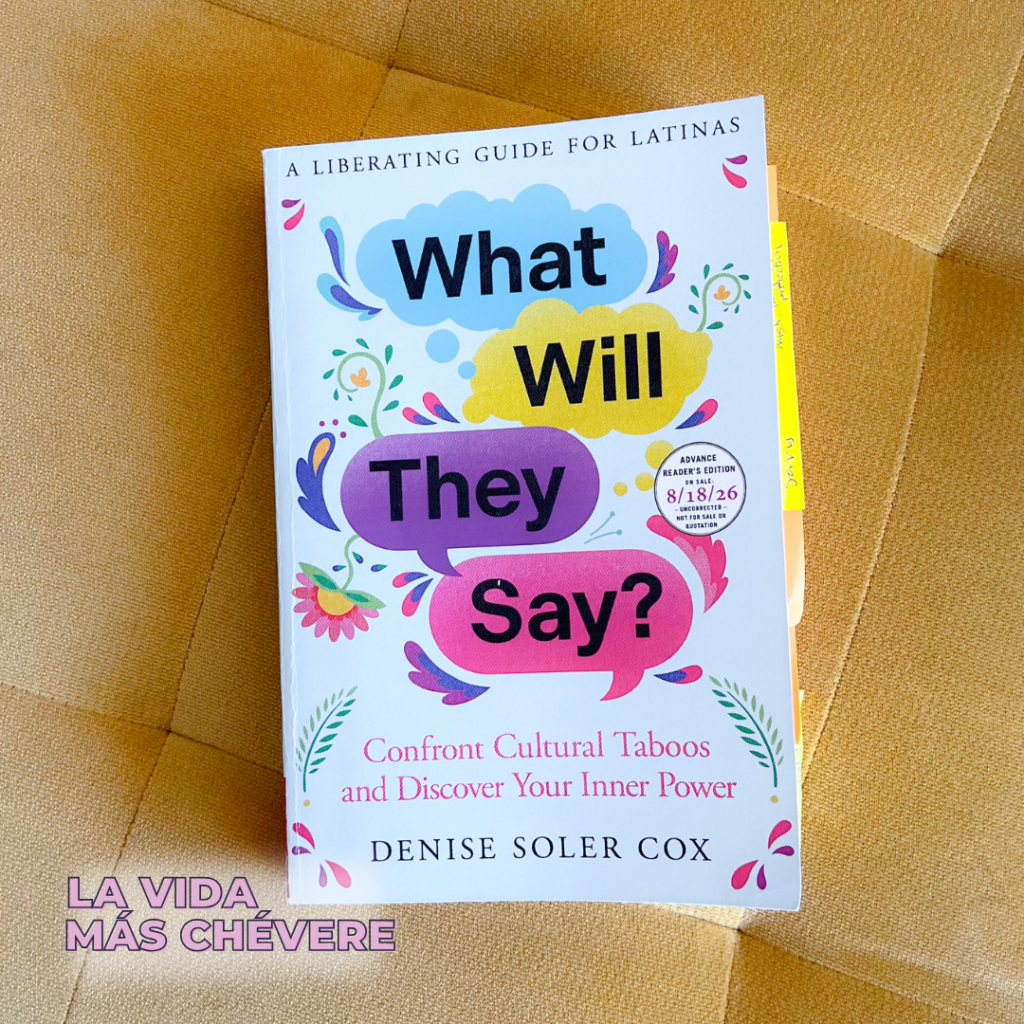
This childfree Latina podcast has never been afraid of that whisper, and neither is our guest. Keynote speaker, filmmaker, and author Denise Soler Cox is fed up by this toxic cultural norm, too. So to celebrate the 100th episode of La Vida Más Chévere, we’re done whispering. It’s time to loudly claim our liberation from the opinions of people we don’t even freaking know!
Through an inspection of Denise’s new book What Will They Say?, we break down what a “good Latina” actually is, how to let go of the struggle tax, and how surrender is sometimes the ultimate step in your healing journey.
Let’s harness our Latina Power and order your copy of What Will They Say? before August 23rd. That’s the magical deadline to make the book a New York Times bestseller. We have that power!
Order here from Simon & Schuster
Chapter Markers
05:47 – How this relates to being a childfree Latina
11:23 – Is being childfree a betrayal to our culture?
13:17 – What is legacy without children?
14:48 – What is a “good Latina”?
18:40 – Extracting the toxic parts of Latinidad
23:59 – Toxic cultural norm: fear of asking for help
26:22 – Private truth telling vs public truth telling
31:23 – She choose not to struggle…
37:50 – The next book
39:40 – Chapter 6: overcoming an emotional vampire
47:02 – Chapter 11: warming up our frozen spaces
54:26 – LATINA POWER: buy the book!
DM me on Instagram if you have questions about this week’s episode. To apply to be on the podcast, fill out this form. And don’t forget to sign up for the LVMC Substack for expanded discussions and behind-the-scenes info on each episode.
If you enjoy what you hear and want to help keep the show ad-free, please support the show!
Also enjoy some limited edition merch, and join the Super Cheveritas so you never miss an episode (or the episode discussions).
This post may contain affiliate links. For more information, please see my Disclosure Policy.*
In this episode
- Pre-order link for What Will They Say? by Denise Soler Cox
- Link for the Spanish version ¿Qué dirán?
- Latino buying power stats from UCLA
- Watch Being Eñye, Denise’s documentary
- The Self-ish Latina Podcast, Denise’s former podcast
- Radical Cultural Self-Awareness, Denise’s TEDx talk
- LVMC episode #57 Repercussions of Media Bias on Arabs, Muslims, & the Childfree with Professor Evelyn Alsultany
- Grief + Light podcast, hosted by Nina Rodriguez
Additional reading
Want more discussion on this topic? Check out these complementary blog posts by joining the Super Cheveritas, or read them directly on Substack. It’s like if a blog and a newsletter had a baby, but it’s childfree!🤩
- coming soon
Transcript created with Descript. Learn more.
Transcript
[00:00] Denise: F it. I am writing a book, and I am going through hell, and I am not going to censor this hell in this book because I don’t wanna look bad in front of people I don’t even freaking know.
[00:13] Paulette: Buen día, mi gente, and welcome back to La Vida Más Chévere de Childfree Latinas. I’m your host and resident childfree Latina, Paulette Erato. And this is where we extract ourselves from all of the toxic cultural bullshit we’ve been sold and design our best lives instead.
[00:32] How you doing? What you’re going to experience today is an emotional episode. I broke down while recording it with our guest, Denise Soler Cox, and also while editing it, so you know it’s good. Trigger warnings all around. Denise just released her first book, What Will They Say? And I gotta tell you, this was the perfect way to celebrate my 100th episode, which yes, this is 100 episodes.
[00:59] Can you believe it? And the reason for that is because the book, What Will They Say?, is very much a complement to this podcast. It’s the book version of everything I’m always trying to convey. And we, as a community of Latinas, have an opportunity to do something incredible with this episode, because it’s coming out the same day as Denise’s book.
[01:21] So here’s what I want you to do. Click the link in the show notes and buy the book. Towards the end of the episode, Denise will tell you why this is so important, so stay till the end, but let me cut to the chase right now. Esos mendigos in power are afraid of Latinas. They’re afraid of our power, otherwise “Latina Power” wouldn’t be trending.
[01:41] We also have the buying power to the tune of over $3 trillion, with a T. Yes, even in this recession. So go buy this book for yourself, for your mama, para tus tias, para las titis, tus hermanas, tus primas, tus madrinas. Hell, any Latina you know, even casually, tell her about it. Get everyone to go out there and buy it, and let’s make Denise a New York Times best seller. Because when she becomes one, and she will, you can say you were part of that Latina Power movement.
[02:17] All right, let’s go talk to her about it.
[02:19] Denise, thank you so much for being here. I have looked up to you for quite some time, so it is such a treat to have you on the show. And even though you’re not childfree yourself, this book that you have written, What Will They Say?, is the complement to this show. I feel like we should have a book club- Ooh
[02:36] so you and I can talk about that afterwards.
[02:39] Denise: Let’s do it. Let’s do it. I’m all in.
[02:42] Paulette: Why don’t you tell us a little bit about what writing this book meant and where the idea came from? Because you talk about in the book the 17 years it took to create your documentary, Being Eñye. How long was the birth process for What Will They Say?
[02:58] Denise: Yeah. It goes back to this exercise that I did with my coaching group called EDA, the Eñye Dream Accelerator, which no longer exists in that form. I do have a group coaching program now, but the very first one I started was called EDA, and it, it was an exercise that I had asked everyone to do and that I participated in myself, and it was a grateful journal.
[03:21] And so basically write 10 things down every single day that you’re grateful for, but grateful from the future. And so I’m so happy and grateful that I’m a New York Times bestselling author. I’m so happy and grateful that my book has reached millions of people. I’m so happy and grateful every single day either writing the same thing or some variation on the same theme.
[03:41] I took that very seriously, and I moved last year and found a humongous box. I’m the queen of journals, and the thing is I love, like, the actual notebooks, right? But now I always have some kind of cute notebook that I write in, and I always have a dedicated one that I did these gratefuls in. And I found them, and it was, like, kinda cool because it was number one on every entry-
[04:05] for months and months. And this was years ago. So I’m gonna say that’s what planted the seed because I always wanted to tell the story on paper. It’s different making a film. They’re all different mediums of storytelling, right? Storytelling from the stage, podcasts in many ways is a stage, and then on, on the page is a stage, and it’s very different.
[04:25] I could say so much about that, but that’s the beginning of that. And then an opportunity came into my inbox in 2021, and that’s what was the first, I would say, official publishing domino. And then it took me two years, about 18 months to get my proposal done. They are not easy. It was not easy for me. I’m what’s called a slow writer even though I write a lot.
[04:47] It takes me a very long time to edit my stuff, and a lot of my stuff is deeply personal, and it was very slow. And imagining a book, beginning, middle end, and then imagining chapters with beginning, middle, end, took a lot of thought. And so that process, I- 18 months, and at the very end of the process, I would say the last six months, I brought on a coach because I just couldn’t get it there.
[05:11] And so there’s something to be said for professionals that can help you with very specific things, and in this case, her name is Rochelle Fredson. She helped me, and I’m forever grateful for her assistance. And then the book went out to the original publisher that, that wanted to see it, and that did not work out. And so then we went on to submission, which is what it’s called when your book proposal goes out to all the different houses and editors, and it was there that it found its home at Simon & Schuster with Primero Sueño Press, which I could not be more excited to have a chance to work with them and continue to work with them.
How this relates to being a childfree Latina
[05:47] Paulette: Thank you for that. So my podcast is all about dismantling the toxic cultural bullshit we all grew up with, right? So we can create our vidas mas chévere. Very much like your documentary, Being Eñe, and now the book, What Will They Say?, explore the same inherited cultural taboos and rules. So what does el qué dirán, what does that look like, you think, for childfree Latinas?
[06:14] Denise: Yeah. I will say it looks like breaking a cardinal rule in the culture. I’m gonna say probably one of the hardest taboos to, quote unquote, “break,” I don’t think anyone thinks that they’re breaking a taboo consciously. Maybe some people know they are. But I will say it’s not just breaking, “Hey, I’m gonna talk about money when we’re not supposed to talk about money,” or, “I’m gonna share about this thing that happened to me when I know I’m not supposed to be sharing.”
[06:43] There’s something more fundamental and core and cardinal and actually central that it feels like whomever decides not to have kids is somehow selfish and/or pobrecita.
[06:58] Paulette: There’s a lot.
[06:59] Denise: It’s like you’re either, either I’m gonna feel sorry for you or I’m gonna call you selfish, and probably lots of stuff in between. But all of that- is, has to be dealt with, and it’s deeply painful. This I know.
[07:11] Paulette: Yeah. I will say that my experience as a childfree Latina I don’t think mirrors a lot, because I wasn’t the first one in my family on either side. Uh-huh. And that’s why this show exists, so that we can talk about- Mm … this spectrum of experiences, right?
[07:26] And I’ve heard from the audience that nobody supports them. So it’s really great to hear a mother herself- Mm-hmm … ’cause I don’t have a lot of them on this show. Mm-hmm. But when a mother herself is like, “No, I recognize in you that you are making a choice here that will hurt.” Mm-hmm. “And that can hurt and can really fracture your foundation of identity as a Latina, as a family member,” so thank you for that.
[07:51] Denise: Yeah, yeah. It’s not just a regular old hurt. It’s, I’m gonna say probably at the top of the list of one of the most, if not the most painful, quote-unquote, “violations.”
[08:00] Paulette: Because as, as a culture, as Latinos in general, not just us Boricuas, as Latinos, the mother is the center of the family, right? She is venerated.
[08:11] She is put on a pedestal.
[08:12] Denise: Mm-hmm. Yeah.
[08:14] Paulette: When you opt out of that, what are you left with?
[08:17] Denise: Yeah. It feels almost… I can’t speak to it personally, but I know from in- my interactions with people, like, the ultimate betrayal of the culture. And this is obviously not what the intention is, but that’s what the outcome is.
[08:30] And that’s what it feels like for a lot of people, and it’s very unfair.
[08:34] Paulette: So in the book, you talk about how you collected these stories in this- Yeah … Line of Secrets and Dreams, that people would come up to you after a screening to tell you their secrets, to tell you their dreams, and maybe to share some of the shame that they had been carrying now that they- Yeah
[08:48] felt they didn’t have to after watching the documentary, which is wonderful, I’m sure. So how often did this conversation come up, women not wanting to have children? Was that one that’s, that was up there or-
[09:02] Denise: No, it wasn’t. Here’s what that tells me. It’s been 10 years since the film came out, so I’ve done over 400 events, and there are some secrets that make the top of the list every single time.
[09:15] It’s often sexual assault. Mm. It’s often domestic violence. I would say those are two at the very top. And when the choice to be childfree ever came up, it landed like the pain was different. Mm. Like, the pain ran way deeper. And because I spoke to thousands of people, I was able to surmise that, in my opinion, it was easier for someone to share about, as hard as this is to believe, sexual assault and domestic violence than it was about making a choice that’s so centrally not okay in our culture.
[09:56] ‘Cause- Yeah … the other two you don’t choose, but this one you do. And let’s say working also, like a career woman or taking the role that I took, those things can be justified, like if they are choices. You know, like, “I’m gonna go out there, I’m gonna have a job, I’m gonna make this movie, I’m gonna be on the road,” and the culture, the family will reframe it and excuse it.
[10:16] And n- not like it needs an excuse, but she cares so much about her family, she’s going out there and she’s making all the money, and she’s bringing it home, and it’s still all about the family. But if, if a Latina decides not to be a mom, there’s no reframing. Mm. How do you reframe that except for to say that there’s something wrong with her?
[10:33] Paulette: Mm-hmm.
[10:33] Denise: And so to me- I interpret that as I didn’t hear it a lot, and when I did hear about it, there was a pain that seemed way deeper. And so I had an interesting vantage point. These women came to me, they shared these things with me, and patterns emerged, and that pattern was very clear to me that this is the deepest pain- Wow
[10:57] very interestingly enough. And it’s because of the lack of frequency, and also because of when it, it was told to me, how clearly much deeper it felt. It… And I don’t wanna rank pain. I do wanna validate an e- an experience that I believe needs to be validated, though.
[11:14] Paulette: Yeah. Childfree women exist.
[11:17] Denise: Yes.
[11:18] Paulette: You can’t just will them away or wish them away.
[11:21] So you brought up career women-
[11:23] Denise: Mm-hmm … ‘
Is being childfree a betrayal to our culture?
[11:23] Paulette: cause as also having a choice. You were talking betrayal. Do you think it’s a sharper betrayal because it touches on motherhood?
[11:30] Denise: Sharper. Yeah. Absolutely sharper, ’cause it has everything to do with, quote-unquote, “you” or the woman, right? A lot of what I talk about in my work, something that’s very central to what I talk about, is the value system collision.
[11:42] And from s- collective we-focused culture, which is what, the culture that we come from, we prioritize family. Everybody knows it. Family comes first, and if there’s ever any kind of change-up to that, it’s mom comes first, right? Mm-hmm, mm-hmm. Or sometimes people say God, but mostly it’s family, and then secondarily it’s mom.
[12:00] And then there’s the self-reliance, which is the individual comes first. That is not our reference point. That is not how we’re taught to exist and manage ourselves in the world. And as a matter of fact, we heavily judge that culture, and that’s why I had a podcast once called The Self-ish Latina Podcast, because I wanted to point to that, and because why should we call ambitious Latinas selfish?
[12:25] Why should they be regarded that way? And I wanted to talk about the reasons why they were regarded that way, which is because we jump, especially first gen and on, we jump from the homeland value system, of course it’s infused in us, and that is challenging and also beautiful at the same time, right? So prioritizing the family I actually think is a beautiful thing, and sometimes it can be a very difficult thing.
[12:49] Paulette: Mm-hmm,
[12:50] Denise: mm-hmm. And if you’re ambitious, you have to… You jump to the self-reliance side, and then it ends up being this ping pong, like a tennis game or whatever. Mm-hmm. And you take from self-reliance, and you take from collective to make it all work, but the woman who is childfree can only be relegated to the self-reliant, which is pooh-poohed and judged, and so that’s why it becomes harder for her.
What is legacy without children?
[13:17] Paulette: Yeah. So legacy, something that you mentioned- Yeah … in the book, which is one of my favorite topics for this show, and you go right on ahead and say, “It’s not biological.” Mm-hmm. Your legacy is not pegged to your children, which for some reason feels like a really progressive thing to say. Mm-hmm. But what does it mean to leave something behind that isn’t motherhood?
[13:36] You have a book, you have a documentary, you have a TEDx talk.
[13:39] Denise: Yeah. Yeah.
[13:41] Paulette: What is your legacy?
[13:43] Denise: To me, it’s the impact. Since I was very young, and probably it’s all connected to what happened when I was nine, that thing that I tried so hard to make sense of for so long, that’s the first story I share in the book.
[13:55] It’s, I’ve always wanted to be a person of consequence. And so the way that I perceive legacy is, what is the impact will my life have made? So to me, legacy means impact, and what, what impact will my life have made? And so of course, my daughters are a part of that.
[14:13] Paulette: Mm-hmm.
[14:13] Denise: Also, my film. And, like, more importantly, how I want my legacy to be perceived is that the thing that I made changed something for the better.
[14:23] That, to me, is legacy. And I guess legacy is also change for the worse. But for me personally, did the things that I made help people? And if it did, then the job was done, and that I can die feeling like, “Okay, I did what I was here to do.” And also have f- two fantastic young women that I couldn’t be more proud of, going out and doing what they’re gonna do in the world.
What is a “good Latina”?
[14:48] Paulette: You mention throughout the book the idea of a good Latina.
[14:53] Denise: Yes.
[14:53] Paulette: This has come up in another conversation that I had with another guest. Her book was about the broken promise made to Muslims in this country. Ah. Talk about second-class citizenry, right?
[15:04] Denise: Mm-hmm.
[15:04] Paulette: And I asked her, “Do you feel like you’re a good Muslim?”
[15:08] And her answer was, “We shouldn’t make those distinctions. My whole point was we don’t need to describe one as good or bad. We just are Muslim.” And I was like, “And we just are childfree,” right? Yes. But the idea of a good Latina is deeply entrenched in our culture.
[15:28] Denise: Yeah. Yes.
[15:31] Paulette: So you have the Good Latina Playbook.
[15:34] Uh-huh. And then you have a task for how to break through that paradigm, right? How to break through that mindset. So based on what you’ve written, Denise, are you a good Latina?
[15:47] Denise: I’m gonna say yes, through and through, and here’s why. Because I do think, I agree with your other guest that, that it, the way that it should be, and also I think that pulling on the thread, it’s super important to decide that we are good.
[16:03] Because I believe that for many of us, we walk around in our subconscious minds believing we’re broken- Mm … and bad, and those are very hard things to admit to other people, but those are the things that were shared with me way, way, way too many times, like a disturbing amount of times. And, and then also I had to reckon with my own beliefs of my own brokenness and my own beliefs of not being good, which is why the exercise, that specific exercise in the book I’m going to say is the most powerful exercise I’ve ever done with a coaching group ever.
[16:40] And the biggest gift that a reader can do is do that exercise and do it in a group of people and share it. Don’t do it alone. But do it and share it so that you can hear other people’s answers, and healing will happen. But declaring and deciding, “No, I am actually… I am good, and I’m good for many reasons, the biggest one of which, my goodness derives because I exist.”
[17:05] A, that means I’m good, and so are you, and so are your listeners, and all people. And the other one is because of my wiring and the reason why I’m here, and the reason why this book exists, is to have some of the hardest conversations maybe somebody will have up to this point in their life, and that makes me a good steward of our culture, because some things need to change.
[17:28] Mm. And I was made aware of those things over and over and over again to the tune of hundreds of events and thousands of conversations, and I am putting myself out there to say in a whole book, trading my most intimate stories, risking all of that, because I know for sure that I am not alone in the suffering, things I’ve had to suffer, and that it’s critical for all of us to know that it’s okay to begin to reckon with these things.
[17:57] And that’s really the way through to our own goodness or to recognizing the truth about our goodness, is through the eye of that needle.
[18:06] Paulette: Well, by the same token, I’m also a good steward of our culture.
[18:09] Denise: You are.
[18:10] Paulette: I’m out here giving the platform to women to just, to have these discussions, right? That makes us stronger.
[18:17] Mm-hmm. When those cracks start to happen in the foundation of our beliefs that were maybe toxic and shouldn’t exist anymore, we really start to create room for expanse- Mm … and for new ways of thinking, and also for letting go of the toxic cultural bullshit.
[18:37] Denise: Yep.
[18:38] Paulette: Right?
[18:38] Denise: Yeah.
Extracting the toxic parts of Latinidad
[18:40] Paulette: In the book, you also talked about living by your own rules-
[18:44] Denise: Mm-hmm
[18:44] Paulette: and still being tied to the culture. From your lens and the experiences you’ve had on the Line of Secrets and Dreams, how do we extract the toxic parts, all those toxic cultural imprints, and keep our Latinidad intact?
[19:00] Denise: It’s one of those things, it’s simple but not easy. So to, to look at it like it’s extractable like a tweezer with, um, a splinter, that is gonna be harder than, than what I’m going to share.
[19:12] The method that I believe has worked for me, and the one that I’ve seen with my clients and with my experience over the last 10 years, is that it’s the examination. Stage one, examine. Be willing to talk about it. And the thing is, I don’t want anyone to think I expect them to put their secrets on blast.
[19:30] This is not what this is. The invitation is talk to one person. There’s some stories that have never left your lips. Things happened. The very first story in the book I have told- Less than, let’s say, five people, maybe just three people before I told it in the book. This is one of the most difficult stories for me to tell and write, but it was a story that was swimming in my mind my entire life, decades and decades and decades since I was nine.
[19:59] And it was in the process of working on that story that a lot of healing happened for me. And so phase one is talking about it, if you can talk to one person, but then also getting into community when you’re ready, when you’re ready. And, like, willingness to hear other people’s stories, and the extraction happens almost without us being aware of it, but here’s what it feels like.
[20:24] It feels light. Everybody knows the people in their life, ’cause everybody has at least one person like this, that makes them feel lighter.
[20:32] Paulette: Mm-hmm.
[20:32] Denise: Like, when you’re with them, you feel like you can do anything. You feel safe to say whatever, and you just feel at ease. Those people I call High Quality Humans.
[20:41] And all of us have at least one in our life, and my recommendation is you surround yourself with people like that. That’s how you know the extraction is happening- Mm … because you are with those people, and you feel that way. ‘Cause what happens is you begin to reveal, and you begin to share the truth, right?
[21:00] And then if you need to be in therapy, which I highly recommend- Yes … spent a lot of my life in therapy and, and healed quite a bit, and healed a lot of it in the writing of this book. And then, you know, slowly but surely have the opportunity to share with other people for two purposes. One, to just, you know, share the truth, and then two, to hold space for the truth to be told, because that also is light.
[21:23] It’s a light feeling. It’s a gift of lightness for all, right? Two of my closest friends r- who read the book, they were like, “You never told us this,” or, “We knew this, but we didn’t know how hard that was for you.” Some things are, might just be easier to write, and I respect that. And then some things you can actually share across the table.
[21:44] So the extraction is a process. It involves at least one other person, and the feeling is lightness, and I don’t know that we’re ever done with it. Sometimes I hear people saying, “Oh, I already did that. Oh, I’m so whatever,” and I never believe them, and I never trust them- Mm … because I’m like, “Show me that you’re not okay with th- this without telling me.”
[22:03] Do you know what I mean? Which is totally fine. We’re all on our own journeys. But I do believe that this is a lifelong thing, and that there’s many layers. And certainly, certain things are, I’m gonna say, s- easier for me now to talk about than others. That is true. And then there are other things still I have yet to feel comfortable with.
[22:23] But that’s my journey, and I respect all of our journeys wherever we’re at.
[22:27] Paulette: Mm-hmm. Mm-hmm. I agree with you about the part where people are like, “Okay, I’m done growing,” right? Or done with whatever the hard work is. But- Yeah … you’re still living, and you’re still experiencing life, and you’re still experiencing new things, and how those things impact you might require more growth.
[22:48] Mm-hmm. But if you’re like, “No, I’m done,” oof, it sounds like it’s just gonna be harder on the back end.
[22:54] Denise: Yeah, and what I find with my own experience is that the higher I reach, and I’ll just use high and low as, like, the aspirational life, right? Mm-hmm. Like, book, and then what’s gonna happen after the book, and, like, the stages I wanna be on.
[23:06] Like, that comes with ch- all kinds of triggers. And so my experience is that it’s like a spiral. “Oh, I’ve been here before. I’ve felt these way. I thought I worked on that so much in therapy. Why is this coming up again?” But it’s not like it’s coming up again in the same form. It’s a different circumstance and a different depth of said thing.
[23:26] And so I know I was able to move past it once before, so I have confidence I can do it again, but man, I am… I’m meeting my maker right now with this book, and it hasn’t even come out yet. And so I recognize, and that’s a wisdom conversation, okay, I can handle it. 30 years ago, this might have broken me and stopped the train, but now I know I’ll be okay, and I just might need more comfort from my husband and from my friends’ support.
[23:55] But I recognize that those are the things that will get me through.
Toxic cultural norm: fear of asking for help
[23:59] Paulette: That’s key because as we get older, all those experiences come with us, right? If we have worked on them and have gotten past them, now we have that wisdom to recognize and ask for help. Yeah. You just said, “I might need to lean on my husband or my friends.”
[24:15] We ask for help. Why is it, this is another toxic cultural norm, why is it we’re so afraid to ask for help? I know. Why is it we’re so afraid to seem weak? When we are a collective culture, that means we should be able to lean on one another, right? Mm-hmm. That’s where it all goes sideways.
[24:33] Denise: It does. It’s like certain things, it’s like the math doesn’t math, and that is a perfect example.
[24:39] That one is expired. That one smells, and it should be thrown away. You know what I mean? There’s mold growing on it. Just get rid of it. It makes no sense at all. Because if we choose to reach out for help, the hands will reach back. Mm-hmm. And yet, the inclination to reach out is often not there, and it was certainly not there for me for a lot of my life.
[25:01] I’m one of those people categorically who contracts when I’m going through a hard thing, and so I can’t tell you how many times friends have said, “You disappeared,” and, “Why didn’t you call me?” Or, “Why didn’t you reach out?” And I can’t tell you how many times I’ve said, “I don’t know.” You know? And that’s the mechanism.
[25:21] That’s what it looks and feels like. It doesn’t feel like, “Oh, I think I’ll not call anybody when I desperately feel like I need help because my culture says it’s wrong.” We don’t consciously make those decisions. The mechanism, however, is working in the background, and some of it’s nature, some of it’s nurture, and then a lot of it’s culture.
[25:38] And I just don’t ask for the help, but now I know how to interrupt it, and I have- Mm-hmm … I have that support system in place. We all have different friends that are like, “Oh my gosh, I know I can tell them, and they will lift me up with this specific thing.” And so that’s what I do, but it’s really hard.
[25:54] Mm-hmm. It’s still hard to do that, but I know that it’s like I crave that lightness, and I, so I insist on strengthening the muscle. But just because I wrote the book does not mean that my muscle is strong for everything- Mm-hmm … ’cause it is absolutely not.
[26:09] Paulette: Oh, God, I love how you put that because weightlifting is a big thing for me.
[26:13] Denise: No kidding.
[26:14] Paulette: Yes, yes. I started doing that 10 years a- or 13 years ago with my husband. Uh-huh. And it’s like a drug.
[26:21] Denise: Wow.
Private truth telling vs public truth telling
[26:22] Paulette: You said something really interesting. I’m gonna quote, and this goes back to something else you mentioned about telling at least one other person and the lightness. Private truth-telling heals you.
[26:33] Public truth-telling heals the culture. And I want to relate this to something I’ve learned about grief. Grief has to be witnessed. A friend of mine who hosts a podcast about grief, she told me that in the aftermath of my father dying earlier this year.
[26:51] Denise: Mm.
[26:51] Paulette: What that meant to me, and what your quote means to me, is that we don’t need to do this alone.
[26:59] Denise: Mm-hmm.
[26:59] Paulette: That it is okay, it is encouraged, it is worth your healing to have other people help carry the burden, even by just witnessing you share it.
[27:11] Denise: Mm. Mm-hmm.
[27:12] Paulette: And so we can heal ourselves, but we can also heal our culture by having these conversations. Mm-hmm. By having the lightness. Tell me more about where that quote came from for you.
[27:25] Denise: Yeah. That is a direct result of the editing process. Mm. And specifically from my editor, Michelle. I mean, she’s a professional editor. That’s what she does. She’s done it for years, and that was one of the moments where, I can’t remember what it said before, but she said, “What about for people that don’t feel comfortable sharing publicly, like you?”
[27:45] Or something like that. And then I was like, “Oh my God, that’s right.” And so it forced me to think, “What’s the distinction here?” And I don’t want anyone to rush, ’cause there’s a story that I tell of an incident that happened at LinkedIn during a Q&A. Someone asked me a question, and I had a choice to make whether I was going to be honest or not.
[28:04] The thing is, is that people, some people aren’t ready. And to be honest, the first step is the private truth-telling. That’s why we don’t do this in a vacuum. Our healing happens in community, and even if the community is just you and your therapist, right? Or you and your bestie or spouse or whomever. And then, though, for some people, they’re able to do public truth-telling, and then that truth-telling, regardless of if they know it or not, and I would say specifically with grief, there’s a spectrum of readiness to be able to say, “That hit me to the core, what you said.
[28:41] Thank you for saying it.” I think there’s a spectrum. There’s some people that are going to be able to say thank you, and there’s other people that it’s going to hit, maybe the majority of people, who will not be able to respond, but with whom it made a huge impact.
[28:56] Paulette: Mm-hmm.
[28:57] Denise: And y- we will never know the impact of some of the public truth-telling that we do, but rest assured, it is landing.
[29:04] A lot of public truth-telling is healing for us, and then we live for the people who say, “Wow, that helped me.” And so for everybody else who’s like, “I wonder if I should share that,” if you feel ready, yes, and you will never know the ripple, but there will be a, a broad one, especially if you’re afraid to share it, ’cause I think the things that we’re afraid to share are the things that others need to hear the most.
[29:29] Paulette: Amen. Amen. You wrote the book that basically validates the entire premise of this podcast as it is. I’m so excited that we’re breaking down those barriers one conversation, one read, one stage at a time. Yes. And not only that, Denise, you get up there on stage, and you represent all of us. Aw. You make it…
[29:53] I’m gonna cry. You make it okay to want to be there too.
[29:58] Denise: Aw, thank you.
[30:01] Paulette: What I wanted to do with this podcast was serve as an example- Mm-hmm … that life can be lived differently. Mm-hmm. And women get to make all kinds of choices. What you are doing with your stories, with your documentary, with your book, and being up on stages, is showing all of us we can do that too.
[30:20] Here’s an example of someone who did it. Okay. Now we have representation.
[30:26] Denise: Thank you for saying that. That’s awesome. Yeah. That’s the best compliment I could ever receive. So thank you.
[30:32] Paulette: You’re out there representing every little girl who has been told that she needs to stay calladita Mm-hmm … refuses to believe it, knows it’s wrong when she hears it.
[30:43] Yeah. Wants to be a good Latina, and is fighting that internal struggle of el qué dirán Mm-hmm … And we don’t need to have that struggle. We have seen that people can run this path- Mm-hmm … and be successful. That’s the other part. Right. Not just financially successful. Obviously, we all need to keep a roof over our head and whatnot, but- Yeah
[31:05] success in feeling whole, success in feeling content- Mm-hmm … success in finding those people that are your lightness, that- Mm-hmm … just let you be you.
[31:16] Denise: You’re welcome, and thank you.
[31:19] Paulette: Hoo. Okay.
She choose not to struggle…
[31:23] Paulette: Speaking of which, another quote from the book, “She chooses not to struggle, and instead she triumphs.”
[31:32] Denise: Yes.
[31:33] Paulette: Can we go deeper on that?
[31:36] Denise: Yes. Last year was a very tough year for me, and I’ve shared this with a few people that are like, “Wow, last year you were still writing the book,” because, you know, the book process, the whole publishing world is so opaque.
[31:48] You don’t really know, like, when does the book completely get out of your hands, and then when does it go into the publishing, actual printing process, and all that stuff? But yes, last summer, August 1st, was my official manuscript deadline, and then there are other deadlines that happened after that. But this time last year, my life was falling apart.
[32:07] I’m totally gonna get emotional. But you know what? Life gets better, and life got better. And last year, yesterday, my husband went into the hospital to the emergency room because we moved out of a home that we’d lived in for a very long time, a nice, big, beautiful house, and my business had… I had catastrophic, devastating financial situation.
[32:33] Paulette: Yeah, you talk about it in the book. You’re very raw and vulnerable in the book, and thank you for that.
[32:38] Denise: Yeah. Oh, thanks for saying that because it was a hard decision, but it was a very deliberate decision to be honest about it, and it went on. It wasn’t one of those things where everything was stripped away like a house burning down overnight.
[32:50] It was a house burning down over time. I would say over about six to eight months, I lost about $200,000 in business, and I’m very optimistic, silver-lining kind of person, so when things stopped, like with a client, when that client lost their job or when they lost their budget or whatever the reasons were, I was always like, “Okay, that’s weird.
[33:11] All right. At least I have these other 10 things happening,” ’cause the way that my business worked was the funnel was big and I was very fortunate that I had a lot of business just coming in at all times, and s- clients were in certain stages, but they often came to me. And so when a client comes to you, it usually means they’re also going to go to the contract.
[33:31] It’s very rare for it not to go to the contract stage. And so had all this business, and this is how things worked, and slowly but surely, I just lost one gig, another gig, until I lost almost every gig. Oof. And, and we needed to move. It was really… It was a very hard decision, but it was something that we had to decide.
[33:51] We moved, and we couldn’t afford movers. And so literally all of us were packing, and so we were doing everything ourself, and my husband, who, he’s like still waters run deep kinda guy, right? Mm-hmm. He doesn’t complain. He’s a good Midwestern guy. He ended up just overexerting himself and ended up in the emergency room.
[34:11] And so then we were able to hire one guy who ended up helping us over the next few days. And so the, the ending of every chapter is basically the point of every chapter, and that came to me very early on, that I wanted to make sure that if you were wondering what this chapter was about, I’m gonna give you something that’s lyrical and, like, just a little few words so that we both know where we are in this journey, in the book, and also in your journey.
[34:41] Because you, when you’re done with this book, you will have taken this journey. We’ll have gone through this together. And so this is a chapter called She Triumphs. Even though the, everything is happening right around her. Mm-hmm. And so we moved to, not this place, but we moved to a, what’s called a garden apartment.
[34:59] It’s basically, like, a basement of this house that was on the periphery of this beautiful park in Denver. I’ve always wanted to live on this side of town, and it’s always been very cost-prohibitive, and the irony was just not lost on me. I’m just like, “Wow, here I am in this cat- financially catastrophic situation, living in a basement.”
[35:19] It was a beautiful apartment, but it was, like, 800 square feet for four people. And as soon as we walked out the door, it was, like, this incredible view. I, my view every morning was this park that I’ve always wanted to live on that is gorgeous, inspiring. Nature inspires me, birds singing inspire me, green inspires me, being outdoors, crispy Colorado air, all of it.
[35:44] And I’m like, “The irony of my situation right now. I can’t believe this.” And I suffered so much and felt so sorry for myself, but I still had this damn deadline, and I was like, “I don’t care what is happening. This is a triumph.” And I also feel like a mess. She triumphs because no matter what, and it’s like what we talked about earlier, life has brought me to my knees a few times, and every time, I got back up again.
[36:16] So that inherent belief of my ability to transcend was what that meant and what I wanted to transfer to the reader
[36:25] Paulette: Beautiful. You also talk about the struggle tax a lot throughout the book. Yeah. And it’s those choices that sometimes are made for us that we carry these burdens, and at some point you have to, like you mentio- it’s such a beautiful metaphor, take the backpack off because you didn’t pack it.
[36:42] And what the hell’s in it? And you can put it down. Ugh, man, yes, stop with the struggle tax. ‘Cause there are some things in life that are hard.
[36:50] Denise: Yes. Yeah.
[36:51] Paulette: Some things in life are hard. We don’t need to make them harder just because that’s the only way we’ve been taught.
[36:57] Denise: And also, there’s a lot of commiserating going on about struggle in the community, and there’s a lot of, “Oh, I guess it’s okay ’cause now we’re all struggling, so I don’t have to believe that there’s anything that I could do.”
[37:10] And not anything I could do, like, in the past, like I suck, I F’d up. That’s not what I’m talking about. I’m talking about anything you can do from this point on to make good on this, to change this, to triumph over this, right?
[37:23] Paulette: Mm-hmm.
[37:23] Denise: There’s, like, this settling in on I guess we all struggle. I guess I’m just gonna kinda give up on my ability to transcend the situation or to believe in even the most smallest of inklings that I’m more powerful than the situation suggests.
[37:39] Paulette: Oh, God, I love that. That was powerful.
[37:43] Denise: Thank you.
[37:43] Paulette: Wow, Denise dropping gems here. I love it.
[37:47] Denise: Thank you.
The next book
[37:50] Paulette: What’s the next book about? I, I’m assuming there will be a next book. You’re such a good writer.
[37:55] Denise: Thank you. I’m toying with two ideas. Once people read it, like, they’re already, already, already people are saying, “Is there gonna be a workbook?”
[38:04] Paulette: Mm-hmm.
[38:05] Denise: And, and I would say that’s one of the ideas, and then there’s also, like, a book-length, like a book, like, What Will They Say, book that, that I’d love to write that is very much an extension of the book.
[38:17] Paulette: The book itself is set up perfectly for a workbook. Yeah. And so, uh, let me know when I can buy that.
[38:23] Denise: Yes. There’s just so much to say. I had to contain these reflections, and, uh, literally I could have made a whole book-length version of, “Here’s what you can do.” And so that’s just, like, the tip of the iceberg on what can be done.
[38:36] But a lot of the book, I just wanted people to experience and then talk. Like, I love the idea of continuums, because it includes everybody and all experiences, right? And I think when someone gets to a certain place in their own healing for certain things, ’cause I think we have a certain degree of healing for all different things in our life, that they are…
[38:55] that they could benefit and are ready for a workbook. Yeah. And so for those people, I would want to create that.
[39:02] Paulette: Okay. Like I said, I’m on your wait list. Because a- again, it’s such a perfect complement to the work I’m doing with this podcast, that I think everybody listening should read this book, absolutely, regardless of whether or not you have children, regardless of what your relationship is with your own mother, which I would love to talk about in a second.
[39:22] Yeah. But what’s interesting is a lot of what you said about your mother, some of it, not all, I experienced with my father.
[39:29] Denise: Ah.
[39:30] Paulette: So I got to read it through that lens.
[39:33] Denise: Interesting.
[39:34] Paulette: And now that he is gone, it was an interesting space to sit in.
[39:39] Denise: Mm-hmm.
Chapter 6: overcoming an emotional vampire
[39:40] Paulette: But let’s talk about your experience. Without quite saying it, chapter six does describe this, your mother comes off as an emotional vampire.
[39:50] She stresses you, and she takes and takes, and it was the expectation that you would continue to give and give. And there’s a point in the book where you say, “I won’t be coming.” And I can just imagine the tension of making that decision.
[40:07] Denise: Yeah.
[40:07] Paulette: Do you agree with my assessment of your mom?
[40:10] Denise: Yeah. It’s hard to hear, but I agree with the interpretation.
[40:14] And yeah, that moment in the car when I decided not to come to this event, here’s what’s weird about it and what I think is really important to communicate, is that I was a very fast no. And in the book I also talk about when I’m confused about something, like a decision, when I don’t know, it’s a no for now.
[40:37] Paulette: Mm.
[40:38] Denise: And there’s that whole thing, remember when that whole thing happened, if it’s not a hell yes, it’s not a yes. Remember when everyone was talking about that? And I, that was so resonant with me and I’m like, “Yeah, I agree with that.” If I’m not a hell yes, then it’s a no. But there’s sometimes some decisions are like, hmm, I don’t know, and then you’re like batting it around, right?
[40:55] I’m a no, but then, eh, maybe I should be a yes. That whole thing, that’s the gray area, and a long time ago, I decided every single time I say yes when I’m an I don’t know, I regret it. Mm. So from now on, I’m gonna be a no unless I am the hell yes or the certainty of the yes. And that day in the car, I was a very fast no.
[41:19] Paulette: Mm.
[41:20] Denise: And I can’t tell you how much I cried when I hung up the phone. It’s like that feeling that we all know When you break up with somebody, like, uh, my experience breaking up with men, when I broke things off, I felt a sense of relief, and that’s how I knew I made the right decision, right? That doesn’t mean that they weren’t painful.
[41:44] And so that’s how I felt that day in the car. I cried my eyes out, but I also had that sense of relief, which told me, “You did good,” and that just because you made the right decision doesn’t mean this isn’t deeply painful. And that is how I would describe the part of my life post that decision. And it, it comes from decades of therapy, and honestly, writing the book helped me so much to really see, to dissect this, and to have the time to dissect it, and it’s not something I wanted to do.
[42:19] I did not wanna write a book about my relationship with my mom. It was something I actually felt deeply embarrassed about, and I did not want to put that on blast. And I cannot tell you how many women out there have told me on the Line of Secrets and Dreams about their relationships with their moms, and how many women I was like, “Oh, wow,” like, and I, I refused to say I knew what they were talking about because I had so much shame about my own relationship.
[42:50] That to me was a, the decision I had to make in the book, “Am I gonna talk about this, and then how much will I talk about this?” And last year, during the chaos of the catastrophe, there was a day where I just said, “F it. I am writing a book, and I’m going through hell, and I am not going to censor this hell in this book because I don’t wanna look bad in front of people I don’t even freaking know.”
[43:18] Paulette: Mm-hmm.
[43:18] Denise: So I’m opening all the doors, and the chips will fall the way they fall. But damn it, it was so freeing for me.
[43:26] Paulette: On the other side of pain is freedom.
[43:28] Denise: Mm-hmm.
[43:29] Paulette: So I have two questions specific to this. One is about the process, and one about, is about your mom. You can choose which one you prefer to answer first.
[43:37] Denise: Yeah.
[43:38] Paulette: How long and how many rounds of edits did that chapter take? Is there still a piece of you that is hoping your mom will change?
[43:48] Denise: I’ll answer the easy one first, a crap ton- … more than any other chapter. And I will say mostly because I wanted to, because I, I wanted to make sure that I, that I told it objectively, and I’m struggling with the words because it’s like our s- our version of any story is subjective by nature, right?
[44:08] Mm-hmm. I wanted to write it in a way that would be most helpful for someone else. So I didn’t want it to be about me, and so I, even though it’s about me and her, and I wanted to preserve as much of her dignity as I possibly could, so a lot of stuff got edited out, and I only left the most important pieces in.
[44:28] Mm-hmm. And then the question about holding out hope that she might change, right? No, I don’t have that hope anymore, and I think that actually it’s a really important part of my healing. It’s… I believe people can change. I write about seeing my father change from a very angry, violent man to a loving, peaceful man.
[44:55] I honestly feel like my belief in people stems from seeing and witnessing my dad change right before my eyes. And a big part of my healing was not in the giving up of my mom that she would change, but accepting that she will very likely never change. And that part of the hope that I was feeling about that was making me feel like if my, if- Like, if I believe in her ability to change, or that maybe she might one day change, or maybe she’ll change after she reads the book, let’s say, then so- some part of my healing was contingent on that.
[45:34] Mm. And it’s like I had to just cut it. I had to untether myself from that hope, not because I’m hopeless, but because it a- and it actually freed me. You know, to know me well, like, and only my closest and dearest friends know the deep pain that I have in that relationship, is to know that I’ve always held out hope, and I didn’t realize that what the key would be to abandon that idea.
[46:01] And not as the way that we abandon children on the side of the road, or puppies or something, but just know I’m interacting with this, like the truth. She’s in her 80s. People don’t change. People do, but it requires so much, right? Think about how hard it is for us to change. Mm-hmm. And to have my healing be contingent on her changing is, like, I…
[46:24] All I had was my past to look at to say, “This is never gonna happen.” And the good news is I can heal without her changing. She can stay the way she is, and I can decide I’m okay despite the, the very real truth that I’ll never get that. May- maybe I will, but I’m, you know, as okay as anybody can be. More okay than I’ve ever been
[46:48] Paulette: I think that deserves a celebration, that right there.
[46:51] Denise: Thank you.
[46:52] Paulette: To have reached that point in your healing is a huge thing, because I think when my father died, I was still waiting for him to change.
[47:01] Denise: Oh, yeah.
Chapter 11: warming up our frozen spaces
[47:02] Paulette: So I know you also wanted to talk about the last chapter.
[47:07] Denise: Yes.
[47:08] Paulette: Chapter 11 ties up the entire book, and this title is everything. Don’t Abandon Your Responsibility for Selfish Dreams.
[47:16] Each of your titles starts with something we’re not supposed to be doing as good Latinas, and then your advice in contrast to it. So chapter 11, Don’t Abandon Your Responsibility for Selfish Dreams. And your advice is Reviving Old Dreams and Making New Promises.
[47:33] Denise: Yes.
[47:33] Paulette: And this is when we hear the whole story of Becoming Eñye being created, right?
[47:41] Yeah. What else do you want people to take away from that final chapter?
[47:45] Denise: Thanks for pointing out that the end of the book is the beginning of the Eñye, ’cause structurally I love that I structured it like that, like a circle. Mm-hmm. And I know, I know you’ll have an appreciation for that, so that’s what happens in chapter 11.
[47:59] How we end is where I share a story about my daughter. So I’ve great relationships with both my girls. And it’s not perfect, but it’s… I’m very proud of it, and w- one of my things that I decided early on was that I would listen to them. I would listen to whatever, anything they would wanna tell me. When they’re little kids and they wanna talk about cartoons, it’s painful, or about just the silliness of elementary school.
[48:21] It’s really painful to stay tracking, you know? Mm-hmm. But I knew if they know that they can tell me this, like, my hope is when they have serious things to tell me, they know I’m gonna listen to those things too. And so I would put this conversation o- somewhere in the middle. It wasn’t silly. It wasn’t very serious.
[48:40] It was just what happened in AP Physics that day with my one daughter, Georgie. And she was sharing with me how she learned this concept, and we were in the kitchen. She was at the counter, and I was doing something like emptying the dishwasher, which is like the story of my life, and just, like, listening, trying to pay attention, trying to be interested.
[48:56] And she shares with me this concept called thermal equilibrium, and it’s about the relationships of warmth and cold in spaces and how it, quote-unquote, “really works.” And one of the things… You know, I’m like, “Well, I don’t get this. Tell me more.” And she said, “Think about if we’re in the woods and we’re all in this cabin and it’s snowing out, and Daddy comes and opens the front door, and then we’re like, ‘Daddy, don’t let the cold in.'”
[49:20] And she said, “The cold isn’t coming in. The warmth is actually leaving the house.” And the whole idea is warmth moves and cold stays. And this is a hard concept because the warmth is actually trying to warm up the world. That’s how warmth functions. And so if we think of our lives as homes and as different rooms in our house as cold or warm- The warm spaces are where truth flows and where communication is easy, where high-quality humans exist, and where your best relationships are with things and people.
[49:54] And the cold spaces are where things feel stuck, where we believe the taboos, we believe that there’s something wrong with us, and we believe in our brokenness, that we’re not good enough, and all the things. Those rooms are in what I call cold storage, and we’ve shut the door in some of these spaces, and we’ve thrown away the key.
[50:13] And the whole premise of the book, and what I say is that the process of writing the book for me was opening all of those doors and sharing with you what was inside, but for the purposes of modeling that the things inside our cold spaces can be defrosted, and they won’t taste like– they won’t be frostbitten.
[50:33] They’ll still be great, and they’ll still be intact, but they’re waiting for us to come and warm them back up again. Because like I said, writing this book has set me free, and it doesn’t mean, however, that it hasn’t been deeply painful or that it’s still not deeply painful, right? However, I am free, and I know the way to deliver our collective freedom is to begin opening these doors and allow warmth to do what it does: warm things up.
[51:02] Some things, though, feel so hard to get to that willingness to be warmth. And that’s why I say for those places, all you have to do is open the door a crack and maybe just tell one person, and maybe that one person is a bestie, someone that can say, “Hey, maybe you should go to therapy,” like a friend told me and, in the book.
[51:22] And that’s the way that we slowly warm up the homes, and that’s the way that we warm up the stuckness in our culture, and that’s why I call it a liberating guide for Latinas, because the big invitation is to get warm. And that’s why I also say we should heal in community, because that is our greatest strength.
[51:45] Paulette: Mm-hmm. It’s such a beautiful ending to this, this journey you take us on. Thank
[51:51] Denise: you.
[51:51] Paulette: And like you said, you modeled it, ’cause it’s through the lens of your stories, but it’s not so specific that we don’t all have something that we can point to that’s like, “Oh, yep, been there, been there.” And these reflections at the end, they’re invitations, right?
[52:10] They’re not work. They’re invitations to examine, and that’s why I call it the complement to this podcast- Mm … because this experience, having you on, having people listen, is an invitation to think differently about life’s choices each and every time- Yeah … with each and every episode, and you get to add another brick to that foundation.
[52:32] Yes. So thank you, Denise. This is- Oh, yeah … this has been quite… I- it came into my life at the right time on my healing journey. I appreciate you sending it to me and cannot wait to buy copies for my own mother For my cousins. I think everybody will find common ground with it. Thank you. We can all heal. We can all heal, and I think that is something that we need to say.
[53:03] We all deserve to heal.
[53:06] Denise: Yes. Yes. If we look at it, like if we get out of the broken paradigm, which is so easy to do, especially when there isn’t a lot of movement or when something fee- it feels impossible to make progress with, those are the things where we’re like, “I guess I’m just freaking effed up. I guess I-
[53:22] there’s something wrong with me because I can’t seem to get past this.” If you just look at that, like the thing in the back of your freezer that’s frozen solid that you have no idea what it even is, but just know if you took that out and put it on the counter, it will thaw because warmth will get to it, and you will be able to see what it is.
[53:40] But unlike that thing in the freezer, it is intact, and it is ready, and it is, it is honestly the doorway to, like, your next level. None of us are broken. We’re just frozen solid in some places. Mm. And that’s why we feel stuck, but this is not a permanent… This is not… It’s as permanent as the things in your freezer, but sometimes you might need a friend to be like, “I’ll hang with you until we’ll figure this out, and we’ll deal with the smell.
[54:05] We’ll deal with whatever comes up, but we’re gonna… You and me, we’re gonna be okay ’cause I’m gonna hang with you as this thing defrosts.” Mm-hmm. We don’t have to do it alone, and we shouldn’t.
[54:15] Paulette: We don’t, and we shouldn’t. Thank you so much, Jenice. This has been absolutely magical. A difficult read at some points, though, because- Yeah, just those feelings that it brings up.
LATINA POWER: buy the book!
[54:26] Paulette: Is there anything else that we should know?
[54:28] Denise: Yeah. So when you said that you wanna buy copies for the people in your life, my editor, one of the things she said to me that, that warmed me up, warmed up the stuck places in me, was, “Denise, this is the kind of book that every Latina will have on her shelf, whether she’s a reader or not, and it’s gonna be something that she pulls out, and she goes to the chapter, and she’ll find what she needs.”
[54:53] And so what I would love to share is that there’s a huge opportunity for a book like this to make it all the way, and when I say all the way, I mean to The New York Times bestseller list. And they say things about our community, publishing does, which is, “Latinos don’t read. Latinos, we don’t care about reading.”
[55:13] And the funny thing is, when I made my movie, that was one of the first encounters I had with someone. She said, “Latinos don’t go to film festivals,” ’cause I was trying to garner support from a local film festival here, and to, to see if they would get behind the movie that we were making. And she said, “We’d love to, but Latinos don’t like to go to movies and film festivals.”
[55:32] And they thought that the only movies that they would see are, like, the, the action thriller types, and that they didn’t care about a movie about, about identity. Hmm. And it, it personally offended me so much that I actually needed to send an apology to that person afterwards because I was… I, I wasn’t very diplomatic with my answer.
[55:51] It really pissed me off. And here I am again hearing that publishing says we don’t buy books and we don’t read books. So any Latina that you know, and I’m talking to your listeners right now, who has a book or has written a book in the past, when we buy our books, we tell publishing how we really are. And so in this case, if you can afford the book, awesome.
[56:14] If you can afford to take it out from the library, that also is an indication, because they track those numbers too. So if you are on board with supporting this book and supporting this conversation and what this book can do for the community, I’d love to have you pre-order the book before August 23rd, because that’s the week that The New York Times watches to see how important this book and these conversations really are.
[56:42] And so I’d love to get your support in that. I’ll share the pre-order link with you, and let’s take the book all the way, and really champion these conversations.
[56:52] Paulette: Let’s show these publishers what our culture’s actually capable of. If they wanna put us in this box-
[57:00] Denise: Yes …
[57:00] Paulette: we’re gonna break out of the fucking box.
[57:02] Denise: We are, and we have.
[57:04] Paulette: Let’s not forget, Latinos have $3.2 trillion worth of buying power. We can buy a few books, and we can get it on The New York Times bestseller. We’re gonna do that, Denise. We’re gonna make it happen. The link will be in the show notes for everyone.
[57:18] Denise: And that’s a burrito.
[57:21] Paulette: Okay, now go buy the book.
[57:23] Go buy the book!