Today’s toxic cultural norm: believing that asking for help is a failure of morality.
Listen here:
Or choose your favorite podcast player:


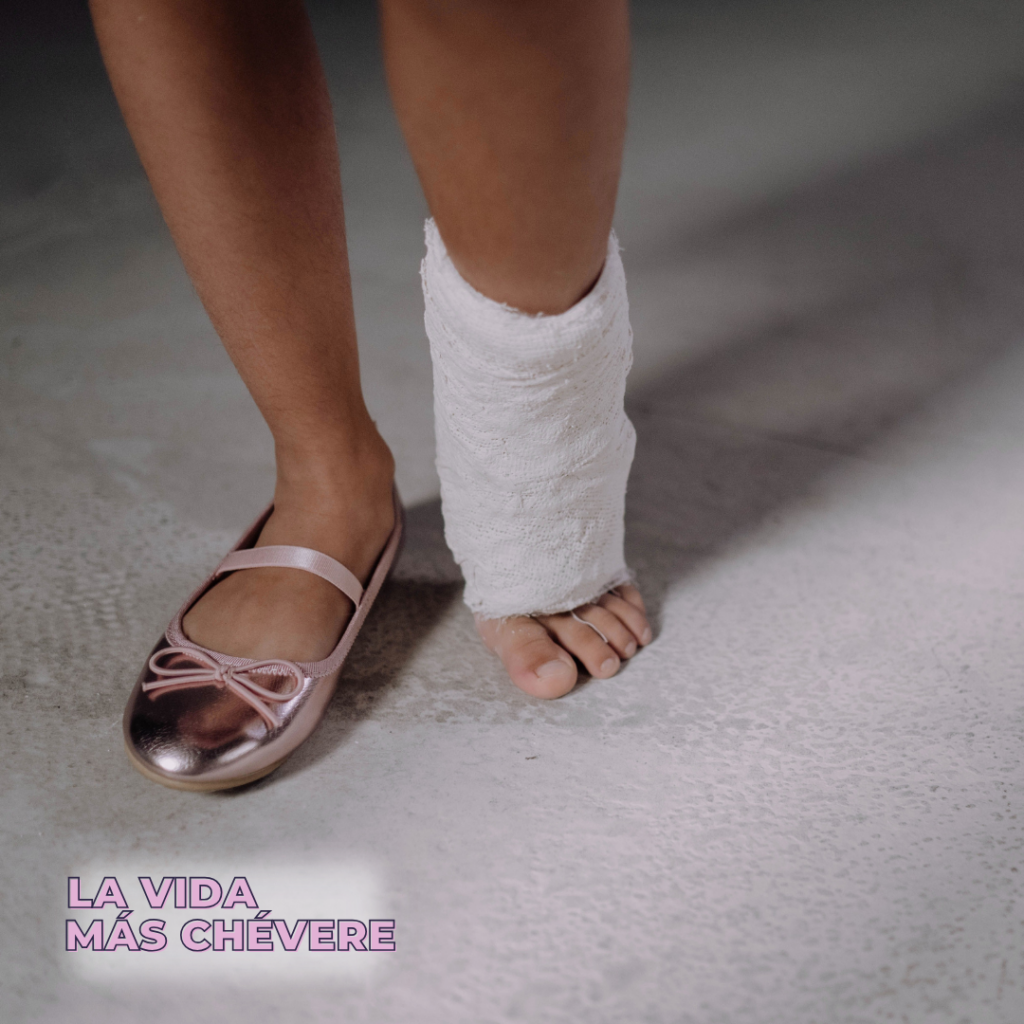
In fact, it’s more like breaking your leg and then denying yourself medical attention. Or crutches. Imagine hopping around like a human pogo stick because you’re too proud to admit you need help!
Refusing help doesn’t make us stronger, it keeps us weak. That’s what trickle-down pendejadas gave us: generational curses passed down until they felt normal. But like Denise Soler Cox taught us, that’s not our backpack. We didn’t pack it, and we don’t have to continue to carry it.
We can start small in asking for help. And eventually, grow our Comfort Zone of Asks until the thing we really want (a raise, a ride to the doctor, etc) stops feeling impossible and becomes an easy request.
Key takeaways:
- Asking for help is just a skill, and you can learn to do it too.
- The patriarchy lied to you to keep you weak. Being strong happens when we rely on the collective.
- When people disappoint us, that’s good intel.
Chapter Markers
00:00 – Intro
01:06 – If you break your leg
05:08 – Get a spotter
10:06 – Practice asking for support
12:22 – Your mission
DM me on Instagram if you have questions about this week’s episode. To apply to be on the podcast, fill out this form. And don’t forget to sign up for the LVMC Substack for expanded discussions and behind-the-scenes info on each episode.
If you enjoy what you hear and want to help keep the show ad-free, please support the show!
Also enjoy some limited edition merch, and join the Super Cheveritas so you never miss an episode (or the episode discussions).
This post may contain affiliate links. For more information, please see my Disclosure Policy.*
In this episode
- LVMC Episode 100: El Qué Dirán: Breaking the Good Latina Myth with Denise Soler Cox
- Order link for What Will They Say? by Denise Soler Cox
- Link for the Spanish version ¿Qué dirán?
- LVMC Episode 95: Grief & Death: What I’ve Learned
- LVMC Episode 37: Perfectionism and Childfree Latinas: The Ivy League School Dropout
- LVMC Episode 96: Failure, Fear, and Generational Trauma: Healing that Mess
- Christian Ortiz (@zacatecho) on Threads
Additional reading
Want more discussion on this topic? Check out these complementary blog posts by joining the Super Cheveritas, or read them directly on Substack. It’s like if a blog and a newsletter had a baby, but it’s childfree!🤩
- coming soon
Transcript created with Descript. Learn more.
Transcript
[00:00] Paulette: Buen día, mi gente, and welcome back to La Vida Más Chévere de Childfree Latinas. I’m Paulette Erato, your host, and a childfree Latina just like you. This is the show where we divorce ourselves from all the toxic cultural bullshit we all grew up with and design our best lives instead. How are you doing?
[00:25] Because me? Whew…
[00:29] This year has tried to break me, but it hasn’t. Sure, I’ve stumbled, and I’ve also asked for help. Not that I was never not that person, but I did go through a phase where being strong meant not asking for help, denying myself assistance. I could do a whole separate episode on that, and maybe I will. But today I’m gonna impart some good old Gen X middle-aged wisdom on you because that era of my life is over.
[01:02] Y te lo juro? It wasn’t worth it.
If you break your leg
[01:06] Paulette: Let’s talk about a possible scenario where you can imagine, visualize even, how idiotic it is to deny yourself support. Let’s say you break your leg. Would you refuse to use crutches? Or would you prefer to spend all of that time that you’re gonna need to heal hopping around like a pogo stick on one leg?
[01:27] See how stupid that sounds? Of course, you wouldn’t try to impersonate a pogo stick because why? You aren’t meant to hop around. You’re a human, not a pogo stick. We have crutches, canes, walkers, even scooters and wheelchairs. And then once you get out of that cast, there’s physical therapy, exercises, walking boots, et cetera, et cetera.
[01:51] There are so many options for support for all different stages of your healing journey. So why would you refuse to ask for help in any other area of your life? Is it the fear of looking weak? ‘Cause honey, if you’re choosing to hop around on one foot like a pogo stick instead of using the crutches, then you already look weak.
[02:18] Not only weak, but you also look like you’re purposely making your life harder than it needs to be. Why would you do that? Do you want to do that? No? So maybe stop denying yourself help. Stop denying yourself the medicine of asking for support, the aid, the crutch, the cane from your community, your family, your friends.
[02:45] This is one of those toxic cultural norms that we’ve all swallowed and allowed to infest us like it’s normal, and it is not. Like Denise said in our last episode about her book, What Will They Say?, we Latinas are a collective culture. Latinidad is a collective culture. Her exact quote was, “If we choose to reach out for help, the hands will reach back.”
[03:12] So stop trying to be strong all on your own. Acting like a pogo stick is straight up pendeja behavior, and you don’t need to claim that. That doesn’t have to be you. Because I know it’s not just you. You didn’t come up with this out of thin air. You learned it from the people around you. Their pendejadas trickled down to you, because pendejadas, that is the trickle-down economy.
[03:41] Those people, their denial of support, making their lives harder so they can win at what, the Struggle Olympics? Come on. And yet somehow that’s been converted into what strength should look like, the equivalent of acting like a pogo stick. And you know why? Because it behooves the patriarchy to keep women from asking for help.
[04:06] It keeps them weak. Oh, you thought you were being strong? Nope, you’ve been sold a lie. Once again, the patriarchy has lied to us. Surprise. So today, let’s dismantle this toxic cultural bullshit, because it probably wasn’t even a conscious lesson. No one actually said to you, “Don’t ask for help.” Instead, they made you feel unsafe asking for help. Or you were actually told no when you did need it. Or you saw how the women around you kept their mouths shut when they were dying to say something, to scream, to yell, a gritar, but they didn’t, because what good would it do?
[04:56] What good would it do? What would change? Mira, that might have been the reality for some, but it doesn’t have to continue to be the reality for you.
Get a spotter
[05:08] Paulette: I’ve got an example of this. Let me get gym bro-y on you for a second, okay? Have you ever heard of a spotter? In the gym, when the weight is too heavy and the lift could fail, another person, or sometimes even several people, will step in to assist, to spot the lifter.
[05:28] Let’s say, for example, I’m trying to bench press. There might be a guy standing behind me watching that lift, so if I can’t push it back up onto the rack, he’s there to catch it. That is typical gym behavior. It’s normal, but green flag normal. It’s the good kind of normal. And I’m sure you’re asking, why would you even attempt a lift that’s too heavy?
[05:50] Because that’s what you’ve been working towards. You have faith in yourself that you can lift it at least once. Maybe previous attempts at it have failed, and in that case, you have a safety option. It’s called a spotter. It doesn’t even have to be someone you know. Gym etiquette dictates that those who can, do, especially if asked. Or if you see someone struggling, you offer.
[06:14] So why would we go through life resisting that same kind of thing in the rest of our lives, in all other avenues of our lives? Why do we believe we have to do everything ourselves? That we have to be in charge of everything? There’s no Eldest Daughter Olympics. You don’t get a gold medal for sacrificing yourself the most.
[06:36] What you do get is burnout, resentment, anger, a desire to burn the whole damn thing down. Or, if you’re really lucky, you get an autoimmune disorder like me. You don’t want that! So please, please just stop it. Instead of burning yourself out on a quest to achieve perfection all alone, which by the way, is not in any way chic, not even kinda, and is definitely not living your vida más chévere, just stop before it gets to that point.
[07:10] There is no glory in being alone and struggling. That, that is pendejadas. That is the trickle-down that you got. In fact, shout-out to Christian Ortiz on Threads, who I’ll link to in the show notes, because he wrote this recently: “Perfectionism isn’t excellence. It’s often surveillance cosplaying as professionalism.”
[07:33] Hmm? Hmm? If you want more on perfectionism specifically, I have an episode for that in the show notes. Look, the truth is that there will be people who can’t or won’t help, and it might shock you. Because lots of people will pretend to be able to help. They may actually even have really good intentions to help.
[07:55] They’ll say things like, “Let me know what I can do. Call me if you need anything.” Things like that. But when you do reach out and you make an ask, all you hear is crickets. It’s disappointing. Sometimes, it can even feel like betrayal. But this is also really important information, as disappointing as it might be in the moment, especially if you’re in a time where you’re feeling vulnerable. Because this is how you learn who your real friends are, who you can actually trust.
[08:28] I talked about getting specific with people about what you need to know in that episode about grief and my dad. But you wanna know something? I’m still surprised and shocked and very disappointed that some of the people I thought were friends have never even sent their condolences about my dad, and yes, I promise you that they know he died.
[08:50] It’s weird, right? People I’ve traveled around the world with. We’ve had dinner in each other’s homes. People who knew my parents! And then my dad died, and nothing? I’m not gonna lie. It is disappointing. It is surprising. But now I know who my real friends are, who I can rely on when shit truly hits the fan, not just when everything is all hunky dory. So I’ve learned that I just don’t waste time or any thoughts on them.
[09:23] I focus instead on the people who did show up, those hands who did reach back. Because I promise you that if you ask enough people, you will find someone willing to help. You just have to open your mouth and make the ask. Because, baby, no one can read your mind. You have to verbalize your needs. You have to speak them out into the world, or type them into an email, or put them in a post.
[09:49] You know what I mean. And this, my dad dying, that’s just one example. One example. There are a trillion other ways that we can ask for support, a trillion other situations where we will need support.
Practice Asking for Support
[10:06] Paulette: So how do you do this? How do you actually ask for support if you’ve lived your whole life never feeling comfortable asking for it?
[10:14] If that’s the case, then it’s gonna be really hard. So we should start this project right away. Because the truth is that asking for help is just a skill like any other, just like walking, remember? We talked about that in the Healing Girl Summer. You learn to walk by falling on your ass. I’ll link that episode for you in the show notes, too.
[10:36] So let’s start small. We start by practicing the small things, little asks. Look, this can be as simple as asking someone to pass you a napkin. Yeah. Let’s say you’re at Taco Bell and you’re like, “Hey, do you mind grabbing a napkin for me?” Simple. Small. I know it sounds silly, but it’s a tiny step towards asking for what you really need. Which maybe looks like asking for help making dinner or with the grocery shopping or creating the menu.
[11:11] I don’t know how I went on a food tangent, but here we are. So you can start really small by just asking for a napkin because you can extrapolate, you can project that out to the rest of your life. What is one little thing, little thing that you can ask for right now that will help you do the asking part, because it’s not embarrassing and it won’t feel like you’re asking for too much?
[11:38] What’s that one little ask that feels comfortable? Because once you can see that one, the next ask can get a little bigger, and then the next ask gets a little bigger than that. Until the thing you really need no longer feels overwhelming and like you’re being weak for asking. You no longer feel like a pogo stick. Because eventually you will be able to ask for something that right now feels like too much.
[12:08] What you’re gonna do is grow your comfort zone of asks so that eventually it’s big enough to encompass that thing, whatever it is you really need.
Your Mission
[12:22] Paulette: So that’s your mission. What is the one thing that you can ask for right now that you need but also doesn’t feel like too much? What is the version of asking for a napkin for you right now?
[12:33] Because when you finish this episode, I want you to go figure out what that is, and then I want you to actually make that ask. ‘Cause what if you want a raise or you need a ride to your next appointment? How do you ask for that if you’re too embarrassed to ask for a napkin? So figure it out. What’s the tiny little ask you can make right now that will get you to the bigger ask later?
[12:57] And there might be 10, 20, 50 little asks that get slightly bigger every time. If you’re lifting weights, you start with the five-pounder, not the 25-pounder, and then eventually you’ll get to the 50-pounder. I promise you, if you keep going long enough, you go from five to 10 to 15 to 20 to 25, all the way up to 50 or more.
[13:21] That’s how it works in the gym and in life, growing our comfort zone. So please, figure out what those little asks are and then go do it. And for extra bonus points, tell me about it. Send me a text. You know you can. The link’s always in the show notes. I wanna know what your ask is, and if you want, I’ll share it in a future episode.
[13:47] And if I get a lot of them from those of you in the audience, maybe I can make a whole episode celebrating all the wonderful ways you are doing that thing that is going to allow you, in the future, to feel comfortable asking for the really big help, the raise, the lowering of your credit card interest rate.
[14:08] I don’t know what that is, but you do. Really, mi amor, let’s end the trickle-down pendejadas. Let’s release the shame that comes from asking for help by simply starting small and working up to the big asks. Let’s get comfortable now, so when we really do need the help, we are ready and equipped to ask for it.
[14:34] And that’s a burrito.